Extracts for English Reading 12+ Test 6
Extract 1
Winston Churchill
by Tejvan Pettinger
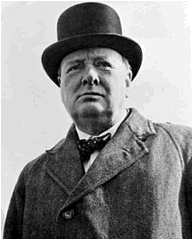
Winston Leonard Spencer-Churchill, (30 November 1874 – 24 January 1965) was a British politician and author, best known as Prime Minister of the United Kingdom during the Second World War. Churchill was famous for his stubborn resistance to Hitler during the darkest hours of the Second World War.
Winston was born at Blenheim Palace, Oxford, to an aristocratic family – the Dukes of Marlborough. He was brought up by servants and friends of the family. He rarely spoke to his father and his mother rarely saw him when at boarding school. Churchill went to Harrow school. He wasn’t the best student, having a rebellious nature and slow to learn; but Churchill excelled at sports and joined the officer cadet corps, which he enjoyed.
On leaving school, he went to Sandhurst to train as an officer. After gaining his commission, Churchill sought to gain as much active military experience as possible. He used his mother’s connections to get postings to areas of conflict. The young Churchill gained postings to Cuba, and North West India. He also combined his military duties with working as a war correspondent – earning substantial money for his reports on the fighting.
In 1899, he resigned from the military and pursued his career as a war correspondent. He was in South Africa for the Boer War, and he became a minor celebrity for his role in taking part in a scouting patrol, getting captured and later escaping.
Churchill returned to the UK in 1900 and successfully stood as a Conservative candidate for Oldham, becoming an MP. In 1904, he made a dramatic shift, leaving the Conservative Party and joining the Liberal Party. Churchill had more empathy for improving the lot of the working class and helping the poor.
In the Liberal Party, Churchill made a meteoric political rise, during which time the government made a significant improvement to the life of the poor, and helped to address the inequality of British society.
What is the use of living, if it be not to strive for noble causes and to make this muddled world a better place for those who will live in it after we are gone?
– W. Churchill Speech at Kinnaird Hall, Dundee, Scotland (“Unemployment”), October 10, 1908,
In 1911, he was made First Lord of the Admiralty – a post he held into the First World War.
On the outbreak of hostilities in Europe, Churchill was one of the most strident members of the cabinet arguing for British involvement in the war. Churchill also used naval funds to help develop the tank – something he felt would be useful in the war. In 1917, Churchill was made Minister of Munitions – a job requiring strong administrative skills to manage limited resources during war. Churchill was considered an efficient and skilled minister.
In 1924 Churchill was appointed as Chancellor of the Exchequer by Conservative Prime Minister Stanley Baldwin. In the 1930s, Churchill was often a lone voice in speaking about the growing danger of Hitler’s Germany.
After an unsuccessful start to the Second World War, the Commons chose Churchill to lead the UK in the war effort. Churchill was instrumental in insisting Britain keep fighting. He opposed the minority voices in the cabinet seeking to make any deal with Hitler. Churchill proved an adept war leader. His speeches became famous and proved an important rallying cry for a country which stood alone through 1940 and 1941.
“We shall defend our island, whatever the cost may be, we shall fight on the beaches, we shall fight on the landing grounds, we shall fight in the fields and in the streets, we shall fight in the hills; we shall never surrender."
Speech in the House of Commons (4 June 1940) Speech in the House of Commons, June 18, 1940
Churchill was involved in many aspects of the war, taking an interest in all areas. After winning the Second World War, Churchill was shocked to lose the 1945 general election, but served as PM from 1951-55 before retiring from politics. Churchill died in his home at age 90, on the morning of Sunday 24 January 1965. His funeral was the largest state funeral in the world, up to that point in time.
Glossary
Gaining his commission – becoming an officer
Article composed with the online WYSIWYG editor. You can subscribe for a membership to remove promotional messages like this one.